Easter Week Proves The Bible | Part Two

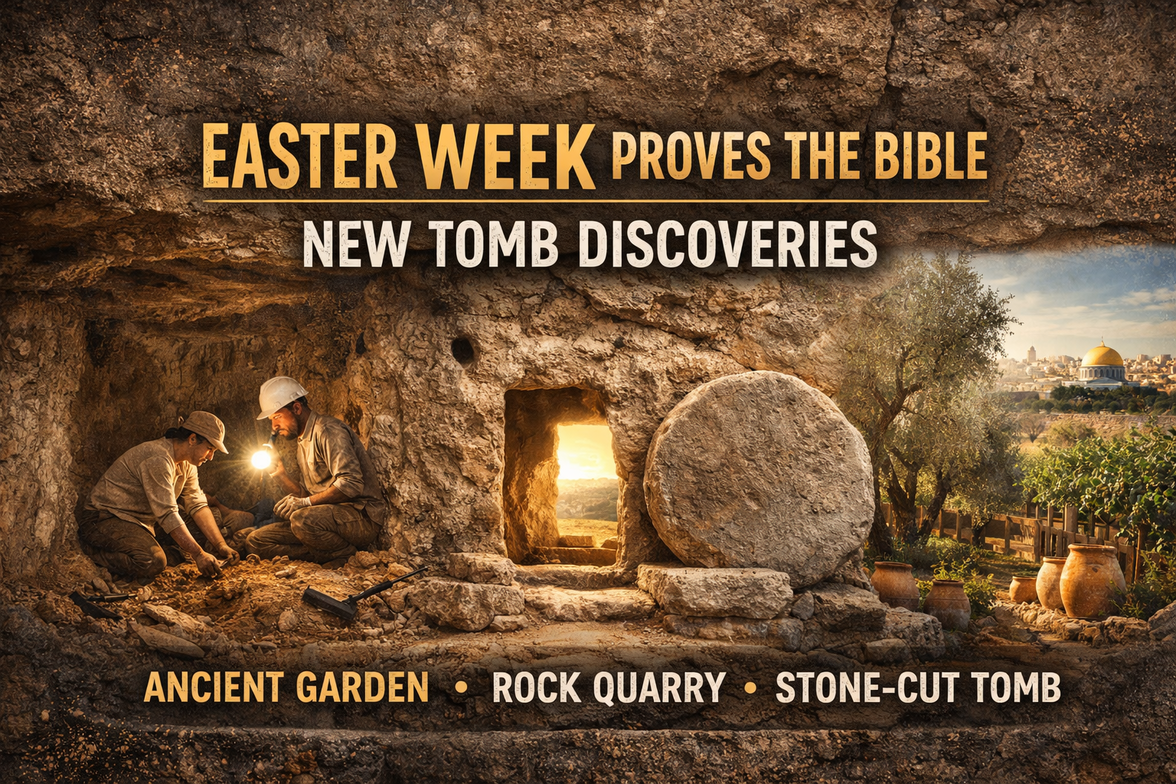
Easter Week, Archaeology, and the Garden Tomb: New Discoveries That Strengthen the Gospel Account
What if Easter wasn’t just a matter of faith — but also supported by archaeology?
Recent excavations at the traditional site of Jesus’ burial, the Church of the Holy Sepulchre in Jerusalem, have uncovered evidence that aligns remarkably with the Gospel accounts of Jesus’ crucifixion and resurrection. These discoveries include a first-century garden, rock quarry layers, and rock-cut tombs — details recorded in the New Testament nearly 2,000 years ago.
Even more compelling, researchers have identified plant remains dating back to the time of Jesus, strengthening the historical reliability of the Gospel narratives.
This is not speculation. This is archaeology.
A Garden Beneath the Tomb of Jesus
Recent excavations led by Professor Francesca Romana Stasolla of Sapienza University of Rome uncovered evidence of a first-century garden beneath the Church of the Holy Sepulchre.
Her team identified:
- Olive pollen
- Grape pollen
- Seeds
- Agricultural soil layers
These findings date back approximately 2,000 years, placing them in the first century AD, the time of Jesus’ crucifixion.¹
This is significant because the Gospel of John records:
"Now in the place where he was crucified there was a garden; and in the garden a new sepulchre…"
— John 19:41
This small detail — a garden near the tomb — is now supported by archaeological evidence.
According to Professor Stasolla:
"We identified olive and grape pollen and seeds dating back approximately 2,000 years."¹
This confirms that the burial site described in the Gospel existed in the exact type of environment recorded in Scripture.
The Rock Quarry Discovery
But the discoveries did not stop with the garden.
Archaeologists also uncovered multiple historical layers beneath the site:
- A limestone quarry
- A garden cultivated in the abandoned quarry
- Rock-cut tombs carved into the quarry walls
This sequence aligns directly with the Gospel descriptions of Jesus’ burial.
The Gospel of Matthew records:
"And laid it in his own new tomb, which he had hewn out in the rock."
— Matthew 27:60
Rock-cut tombs in first-century Jerusalem were often carved into abandoned quarries, where soft limestone allowed for burial chambers to be carved into the rock face.²
This means archaeology confirms:
- A quarry
- A garden
- A rock-cut tomb
Exactly what the Gospels describe.
Dating the Discovery to the Time of Jesus
Professor Stasolla’s team dated the pollen and seeds to approximately 2,000 years ago, placing the site in the first century AD.¹
When combined with historical dating of the crucifixion — discussed in our previous article, "Easter Week Proves the Bible" — this aligns with A.D. 33, the widely accepted year of Jesus’ crucifixion based on:
- Roman historical records
- Astronomical calculations of Passover
- Gospel chronology
- Daniel 9 prophetic timeline
(See: Easter Week Proves the Bible — previous article)
https://rallypoint.church/blog/easter-week-proves-the-bible
This means:
- The Gospel describes a garden
- Archaeology finds a garden
- The dating matches the time of Jesus
- The historical timeline aligns with A.D. 33
This convergence of archaeology, history, and Scripture is compelling.
And One More Detail
Archaeologists have excavated the site.
They have uncovered:
- The quarry
- The garden
- The tombs
But they have not uncovered one thing.
A body.
Because, as the Gospels record:
"He is not here: for he is risen…"
— Matthew 28:6
The Gospel writers recorded small, specific details:
- A garden
- A rock-cut tomb
- A burial site near crucifixion
Two thousand years later, archaeology is confirming those details.
These discoveries do not create faith — but they strengthen the historical reliability of the Gospel accounts.
Easter is not just theology.
It is history.
And the ground beneath Jerusalem is still telling the story.
Verified Sources (2022–2025 Discoveries)
2025 — Garden Discovery Under the Tomb
- Archaeologists discovered olive and grape pollen dating back ~2,000 years beneath the Church of the Holy Sepulchre, reinforcing John 19:41 describing a garden near Jesus’ tomb.
Source: - https://aleteia.org/2025/03/24/garden-found-beneath-church-of-holy-sepulchre-echoes-gospel-account/
2025 — Francesca Romana Stasolla Statement
- Professor Francesca Romana Stasolla identified olive and grape pollen and seeds dating back approximately 2,000 years, confirming a quarry → garden → tombs sequence.
Source: - https://www.jpost.com/archaeology/archaeology-around-the-world/article-851319
2025 — Botanical Evidence Confirmed
- Archaeologists confirmed olive trees and grapevines at the burial site from the time of Jesus.
Source: - https://www.popularmechanics.com/science/archaeology/a69543170/jesus-tomb-garden-church/
2022–2025 Excavation Timeline
- Excavation began May 2022 under Sapienza University led by Francesca Romana Stasolla.
Source: - https://www.custodia.org/en/news/statement-state-conservation-work-floor-basilica-holy-sepulchre/
2023 — Official Excavation Report
- Official Sapienza University excavation report published June 14, 2023
Source: - https://www.custodia.org/en/news/report-archaeological-excavation-work-basilica-holy-sepulchre/
2023 — Excavation Update
- Additional 2023 excavation update confirming ongoing archaeological work beneath the tomb
Source: - https://www.custodia.org/en/news/update-on-the-archaeological-excavation-work-at-the-holy-sepulchre-complex-in-jerusalem/