5 W's of John 3:16

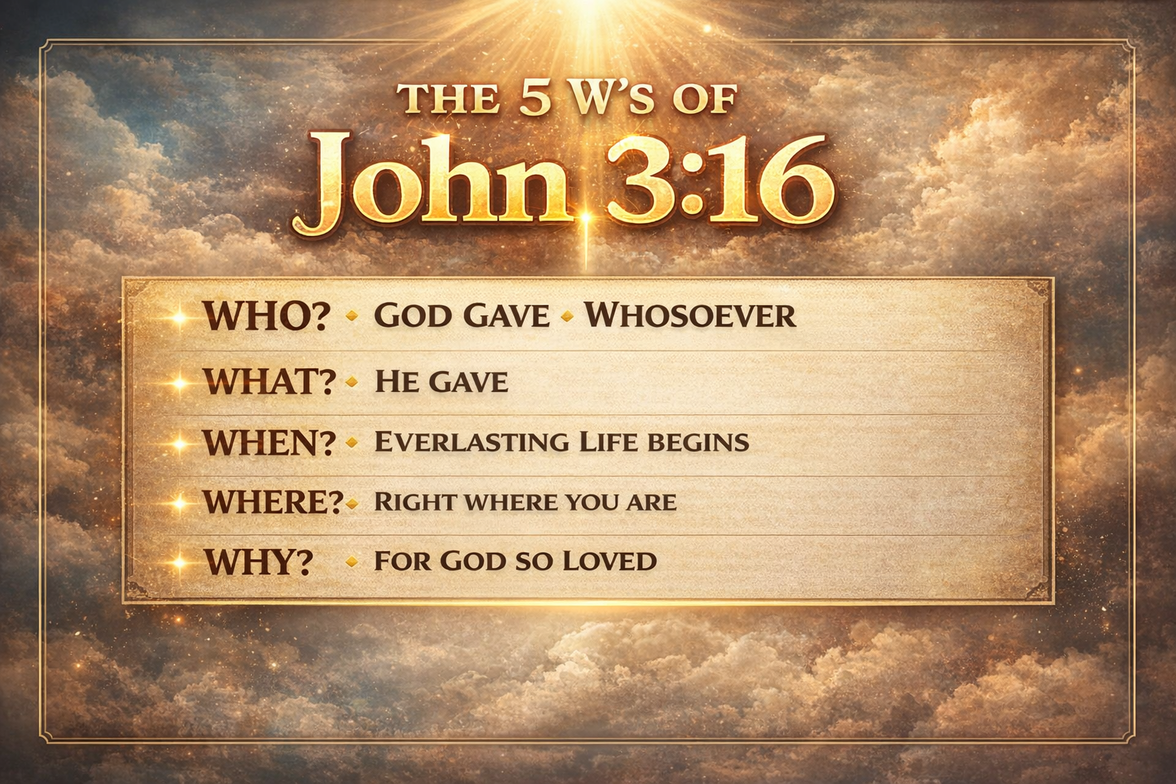
The 5 W’s of John 3:16
Sermon Question:
What in my life shows you that I believe in Jesus?
You can usually tell what someone believes in.
You can tell by the way they live, the way they speak, the way they carry themselves, the way they suffer, and the way they stand.
So here is the question:
What in my life shows you that I believe in Jesus?
Main Text
John 3:16 — KJV
“For God so loved the world, that he gave his only begotten Son, that whosoever believeth in him should not perish, but have everlasting life.”
I. WHO?
There are three “who’s” in this verse:
- God
- His only begotten Son
- Whosoever
1. God the Father
A lot of people talk like the Father is mean, distant, or cold. But John 3:16 says the opposite. It is the Father who loved. It is the Father who gave.
This is the Creator. This is the God of the Jews. This is the God Nicodemus came to speak with in the night.
Acts 6:7 tells us that a large number of priests were saved. Even those who had spent their lives in religious structure were being awakened to the truth.
And many are being saved even now, in places like China, by coming to know the Creator.
Job 33:4 — KJV
“The Spirit of God hath made me, and the breath of the Almighty hath given me life.”
He made us. He gave us breath. And yet we have run from Him. The very core of man is broken.
2. The Son
The second “who” is the Son.
God did not merely send a prophet. He gave His only begotten Son.
Jesus says things no mere man can say:
- I am the light
- I am the way
- I am the truth
- I am the life
- I am
A. “Only begotten”
In John 3:16, “only begotten” is μονογενής (monogenēs). In current Greek study, that word is usually understood as one and only, unique, one of a kind. The stress is that the Son is uniquely from the Father in a category all His own.
Philippians 2 uses different language:
ἐν μορφῇ θεοῦ ὑπάρχων (en morphē theou hyparchōn)
“existing in the form of God”
That is not begotten language. That is nature, status, and condition language. Christ already exists in the form of God before the humiliation of Philippians 2:7–8.
So:
- John 3:16 — μονογενής: the unique, one-of-a-kind Son
- Philippians 2:6 — ἐν μορφῇ θεοῦ ὑπάρχων: Christ already existing in the form of God
Colossians 1:15 — KJV
“Who is the image of the invisible God, the firstborn of every creature:”
B. We know the Father because we know the Son
John 14:9 — KJV
“Jesus saith unto him, Have I been so long time with you, and yet hast thou not known me, Philip? he that hath seen me hath seen the Father…”
If you want to know what God is like, look at Jesus.
3. Whosoever
The third “who” is whosoever.
That means the door is open.
Who can be saved?
Anybody.
Who can believe?
Anybody.
Who can come?
Whosoever will.
Matthew 7:7–8 — KJV
“Ask, and it shall be given you; seek, and ye shall find; knock, and it shall be opened unto you:
For every one that asketh receiveth; and he that seeketh findeth; and to him that knocketh it shall be opened.”
A. You can make a choice, and you are destined. Both are true.
That is one of the powerful tensions in Scripture.
Ephesians 1:4–5 — KJV
“According as he hath chosen us in him before the foundation of the world, that we should be holy and without blame before him in love:
Having predestinated us unto the adoption of children by Jesus Christ to himself, according to the good pleasure of his will,”
Romans 8:29 — KJV
“For whom he did foreknow, he also did predestinate to be conformed to the image of his Son, that he might be the firstborn among many brethren.”
And yet you are still called to hear, respond, and believe.
Matthew 11:15 — KJV
“He that hath ears to hear, let him hear.”
B. Whosoever means sinner
Whosoever is not talking about the polished, the perfect, or the self-righteous.
Whosoever means sinner.
Matthew 5 shows that the attitude of a lost, humble, broken sinner seems to be the prerequisite for eternal life.
Romans 5:8 — KJV
“But God commendeth his love toward us, in that, while we were yet sinners, Christ died for us.”
II. WHAT?
“That he gave…”
What happened in this verse?
God gave.
1. God gave
The gospel is not about man reaching up.
It is about God coming down.
Ephesians 2:8–9 — KJV
“For by grace are ye saved through faith; and that not of yourselves: it is the gift of God:
Not of works, lest any man should boast.”
Every other system says climb.
The gospel says He gave.
Christianity is not the story of man reaching up. It is the story of God coming down. God gives life; false gods leave men dying. God gives grace; false religion leaves men in bondage. God gives His Son for sinners; the systems of this world demand that sinners save themselves. But helpless sinners cannot save themselves. That is why God gave.
Other religions give you a path.
Jesus gives you Himself.
Other religions tell you to climb.
Jesus comes down.
Other religions say try harder.
Jesus says, “It is finished.”
2. What did He give?
He gave His Son.
He gave the Lamb.
He gave the atonement.
1 Peter 1:18–19 — KJV
“Forasmuch as ye know that ye were not redeemed with corruptible things, as silver and gold, from your vain conversation received by tradition from your fathers;
But with the precious blood of Christ, as of a lamb without blemish and without spot:”
3. What do we receive?
This is where your sermon really opens up.
At the atonement, you point to three things purchased:
- Ontos
- Resurrection
- Legal requirement / Penal substitution
And when you preach this, you paint it like this:
- no tears
- no sorrow
- no death
- no mourning
- joy instead of curse
- heaven coming to earth
- all things made right
Revelation 21:4 — KJV
“And God shall wipe away all tears from their eyes; and there shall be no more death, neither sorrow, nor crying, neither shall there be any more pain: for the former things are passed away.”
This is not just endless existence.
This is life with God made right again.
III. WHEN?
When do you get everlasting life?
This is one of the strongest moves in the sermon.
The answer is:
Right now.
1. Eternal life begins now
You do not begin eternal life the moment your body drops in a hospital room. Eternal life begins the moment you believe.
You brought in the image of the dying man in the hospital room, in panic, saying:
“The devil is here. I can hear his voice. He is accusing me.”
And into that fear comes the promise of God.
Ephesians 1:13–14 — KJV
“In whom ye also trusted, after that ye heard the word of truth, the gospel of your salvation: in whom also after that ye believed, ye were sealed with that holy Spirit of promise,
Which is the earnest of our inheritance until the redemption of the purchased possession, unto the praise of his glory.”
Romans 8:38–39 — KJV
“For I am persuaded, that neither death, nor life, nor angels, nor principalities, nor powers, nor things present, nor things to come,
Nor height, nor depth, nor any other creature, shall be able to separate us from the love of God, which is in Christ Jesus our Lord.”
2. What does that change now?
It changes how you suffer.
It changes how you fight.
It changes how you endure.
2 Corinthians 4:8–9 — KJV
“We are troubled on every side, yet not distressed; we are perplexed, but not in despair;
Persecuted, but not forsaken; cast down, but not destroyed;”
Trouble is real.
Perplexity is real.
Ridicule is real.
But abandonment is not.
John 16:33 — KJV
“These things I have spoken unto you, that in me ye might have peace. In the world ye shall have tribulation: but be of good cheer; I have overcome the world.”
3. Death does not get the last word
1 Corinthians 15:54–55 — KJV
“So when this corruptible shall have put on incorruption, and this mortal shall have put on immortality, then shall be brought to pass the saying that is written, Death is swallowed up in victory.
O death, where is thy sting? O grave, where is thy victory?”
IV. WHERE?
1. Right where you are
This is one of the defining images in your sermon:
Golgotha over Gehenna.
2 Chronicles 33:6 — KJV
“And he caused his children to pass through the fire in the valley of the son of Hinnom…”
That valley became associated with judgment, rebellion, death, and the horror of sin.
And then Christ goes to the skull place.
John 19:17–18 — KJV
“And he bearing his cross went forth into a place called the place of a skull, which is called in the Hebrew Golgotha:
Where they crucified him…”
You can come to Christ right where you are.
Right over the ashes.
Right over the curse.
Right over the place of shame.
2. Everywhere
The gospel is not bound to one nation, one culture, or one class of people.
You referenced the repeated testimony from Muslim-background believers that dreams and visions played a role in drawing them to Christ. That fits your broader point: God is still reaching people everywhere.
V. WHY?
“For God so loved…”
This is the heart of the verse.
People debate all kinds of things.
But John 3:16 gives the reason plainly.
Why?
Because God so loved.
1. The reason is love
Romans 5:8 — KJV
“But God commendeth his love toward us, in that, while we were yet sinners, Christ died for us.”
That fits beautifully with the shepherd imagery:
Luke 15:4–6 — KJV
“What man of you, having an hundred sheep, if he lose one of them, doth not leave the ninety and nine in the wilderness, and go after that which is lost, until he find it?
And when he hath found it, he layeth it on his shoulders, rejoicing…”
He did not save you because you were impressive.
He saved you because He loved.
2. You are His treasure
This is where the sermon lands with force:
- He gave
- He gave the Lamb
- He gave everlasting life
That is the gospel.
Not that you climbed.
Not that you cleaned yourself up.
Not that you earned your way in.
But that God so loved that He gave.
And the question remains:
What in my life shows you that I believe in Jesus?