The Image of God | 3 Ways Human's reflect God's Image

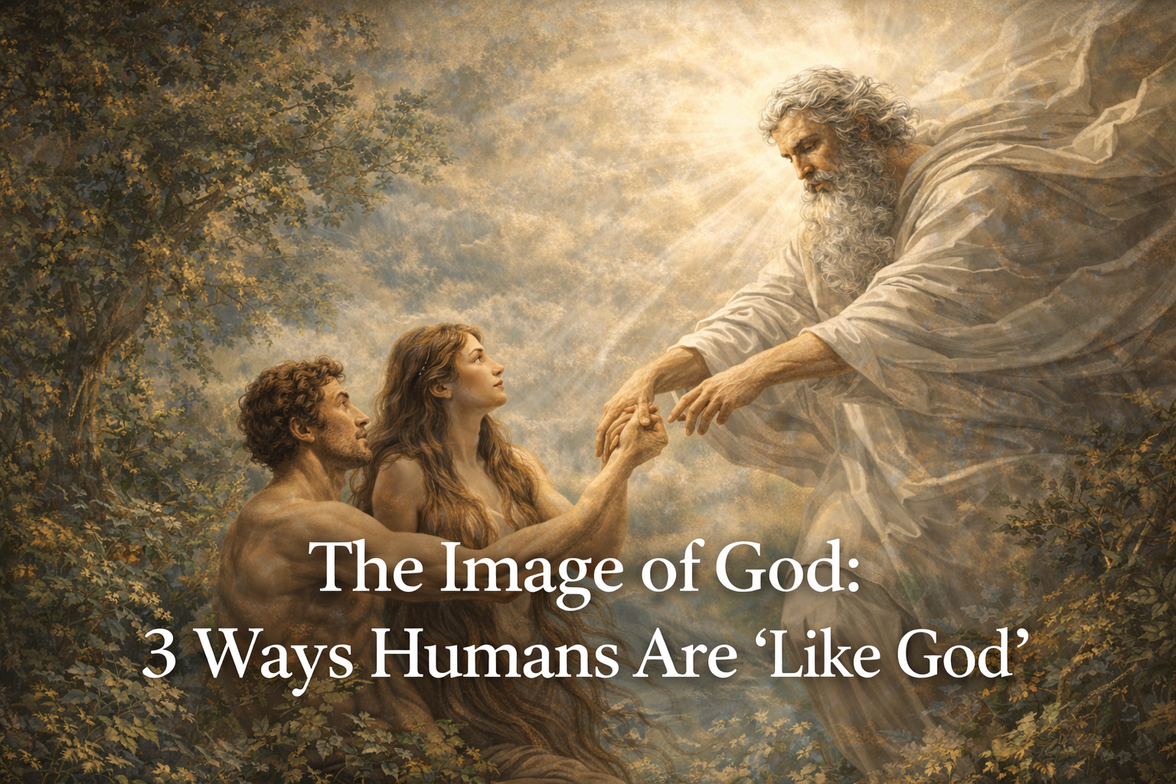
The Image of God: 3 Ways Humans Are “Like God”
Key Text: Genesis 1:27
“So God created mankind in his own image, in the image of God he created them; male and female he created them.”
Introduction
The image of God is one of the greatest truths in all of Scripture. Human beings are not accidents. We are not random collections of matter. We were made by God, in the image of God, and that means something.
From the very beginning, the Bible presents humanity as unique in creation. We were made to reflect God in a way the rest of creation does not. These notes focus on three ways humans are “like God”:
- Oneness
- Creators
- Dominion
There is also something powerful in the way Scripture presents the human story as coming from one man and one woman.
Acts 17:26
“And He made from one man every nation of mankind to live on all the face of the earth …”
Romans 5:12
“Therefore, just as sin came into the world through one man, and death through sin, and so death spread to all men because all sinned.”
1 Corinthians 15:22
“For as in Adam all die, so also in Christ shall all be made alive.”
1 Corinthians 15:45
“Thus it is written, ‘The first man Adam became a living being’; the last Adam became a life-giving spirit.”
There is a unity to the human race that Scripture has always taught.
First, if we all came from a pair, our genes would be very similar, like we were all family. No matter our skin tone or accent, humans are 99.9 percent genetically identical.
Second, scientists traced mitochondrial DNA and found it funnels back to one ancient woman, nicknamed “Mitochondrial Eve.”
Third, the Y-chromosome, passed only from father to son, also converges on one man, called “Y-chromosome Adam.”
The Bible’s story is not one of division at the deepest level. It is one of origin, unity, fall, and redemption.
1. Oneness
Genesis 1:26
“Let us make man in our image, after our likeness; and let them…”
Deuteronomy 6:4
“Hear, O Israel: the LORD our God, the LORD is one.”
God is one, and in some way humanity reflects that oneness.
All creatures are made from dust, including man. But Eve is made from Adam’s side. Rib, core, soul, heart. Adam looks at her and says, in effect, “bone of my bone.” She is one with him. She is me.
And then Scripture says the two shall become one.
Matthew 19:4–6
“He answered, ‘Have you not read that he who created them from the beginning made them male and female, and said, “Therefore a man shall leave his father and his mother and hold fast to his wife, and the two shall become one flesh”? So they are no longer two but one flesh. What therefore God has joined together, let not man separate.’”
This is bigger than modern arguments about concessions, fairness, hurt, technicalities, and what we can get away with. This was written into a world full of polygamy and a world where women were often treated as property. Even there, God’s design was radically countercultural.
Adam and Eve were a providential union by God.
This is one reason the idea of a God-ordained spouse has such deep roots in Jewish thought.
The core Talmudic statement:
“Forty days before the formation of the embryo a heavenly voice proclaims: ‘The daughter of So-and-so is for So-and-so.’”
— Talmud Bavli, Sotah 2a
This is the idea later expressed in the word bashert — destined.
There is also the Midrashic picture of God the Matchmaker. In Genesis Rabbah 68:4, a Roman matron mocked Rabbi Yose bar Ḥalafta for saying God makes matches. She tried to arrange a thousand couples overnight, and by morning they were all fighting. His answer was that making matches is as hard as splitting the Red Sea. The point: only God truly unites soul-mates.
This is the greatest love story ever told, and it is even reflected in our bodies.
Modern studies show that when a woman carries a child, some of the baby’s cells cross the placenta and remain in her tissues, even in the brain. This phenomenon is called fetal microchimerism. It has been documented in maternal blood, bone marrow, thyroid, heart, and other organs.
There is something profound in the biblical idea of oneness. It is not shallow. It is not symbolic only. It is deep, covenantal, embodied, and spiritual.
2. Creators Like God
Genesis 1:28
“Be fruitful and multiply and replenish the earth.”
Genesis 5:3
“When Adam had lived 130 years, he fathered a son in his own likeness, after his image, and named him Seth.”
To be made in God’s image means, in part, that we create.
That begins in the family. Children bear likeness. They may look like us, but likeness is deeper than appearance.
You can say of a child, “He looks like me,” but that is not the only way he is in your image. A child shaped by your love, discipline, teaching, and presence is also formed in your image.
People ask, “Which ones are yours?”
And the answer is: all of them.
Why? Because even the ones that do not share your blood can still be fashioned in your image through love, discipleship, and fathering.
That is true in families. It is true in ministry. It is true in discipleship. It is true in missions.
We are all children of a man and a woman, unless we are clones or lizard people. But stop for a minute and imagine what life would be without sin. Imagine what all of this was meant to be. Imagine what heaven will be like with no sin.
And this is not just about having children.
We are called to create things. To build. To craft. To make beauty. To shape culture. To bring order where there is chaos.
Exodus 31:3–5
“I have filled him with the Spirit of God, with ability and intelligence, with knowledge and all craftsmanship … to devise artistic designs … to work in every craft.”
Stop trying to be someone else. God made you to create.
Some create businesses.
Some create homes.
Some create art.
Some create music.
Some create order.
Some create sermons.
Some create systems.
Some create safe places for people to heal and grow.
That impulse to make, form, build, and fashion is not random. It reflects the God whose image we bear.
3. Dominion
Genesis 1:26
“and let them have dominion…”
The image of God is not only about identity. It is also about assignment.
Human beings were made to rule under God. Not to dominate selfishly, but to bring God’s order, God’s goodness, and God’s ways into the world.
Ecclesiastes 3:13
“… everyone should eat and drink and take pleasure in all his toil—this is God’s gift to man.”
Matthew 6:10
“Your kingdom come, your will be done, on earth as it is in heaven.”
Colossians 1:13, 20
“He delivered us into the kingdom of His beloved Son… to reconcile all things to Himself.”
Dominion means stewardship. Responsibility. Guarding. Leading. Cultivating. Bringing what is under our care into alignment with the will of God.
Specifically for men
Genesis 2:15–17
God put the man in the garden to work it and keep it — to guard it.
That means Adam was not called merely to exist in the garden. He was called to protect what God had entrusted to him.
Dominion is not passive. It is not laziness. It is not abdication.
It means you guard what God gave you.
You guard your home.
You guard your marriage.
You guard your children.
You guard your mind.
You guard your church.
You guard your calling.
And you do that by living under the Word of God.
Joshua 1:8
“This Book of the Law shall not depart from your mouth, but you shall meditate on it day and night … so you may be careful to do according to all that is written in it.”
Psalm 119:11, 105
“I have stored up your word in my heart, that I might not sin against you … Your word is a lamp to my feet and a light to my path.”
Matthew 4:4
“It is written, ‘Man shall not live by bread alone, but by every word that comes from the mouth of God.’”
Luke 11:28
“Blessed rather are those who hear the word of God and keep it!”
John 15:7
“If you abide in Me, and My words abide in you, ask whatever you wish, and it will be done for you.”
You cannot exercise godly dominion apart from God’s Word.
If the first Adam failed in the garden, the last Adam succeeded. Jesus obeyed where Adam fell. Jesus guarded truth where Adam compromised. Jesus resisted the tempter with the Word of God.
So dominion in Christ is not chest-beating self-assertion. It is surrendered strength under the authority of God.
(Sources)
Low human genetic diversity (≈ 99.9 % identical)
National Human Genome Research Institute. Genetics vs. Genomics Fact Sheet. Accessed April 18, 2026. https://www.genome.gov/about-genomics/fact-sheets/Genetics-vs-Genomics
Universal maternal ancestor (Mitochondrial Eve)
Cann, Rebecca L., Mark Stoneking, and Allan C. Wilson. “Mitochondrial DNA and Human Evolution.” Nature 325, no. 6099 (1987): 31–36. https://doi.org/10.1038/325031a0
Universal paternal ancestor (Y-chromosome Adam)
Poznik, G. David, et al. “Sequencing Y Chromosomes Resolves Discrepancy in Time to Common Ancestor of Males versus Females.” Science 341, no. 6145 (August 2, 2013): 562–565. https://doi.org/10.1126/science.1237619
Most genes present in two copies/alleles per individual
National Human Genome Research Institute. “Allele.” Talking Glossary of Genetic Terms. Accessed April 18, 2026. https://www.genome.gov/genetics-glossary/Allele