REBEKAH: WHAT DO YOU DO WHEN ALL YOU HAVE IS GOD’S WORD?

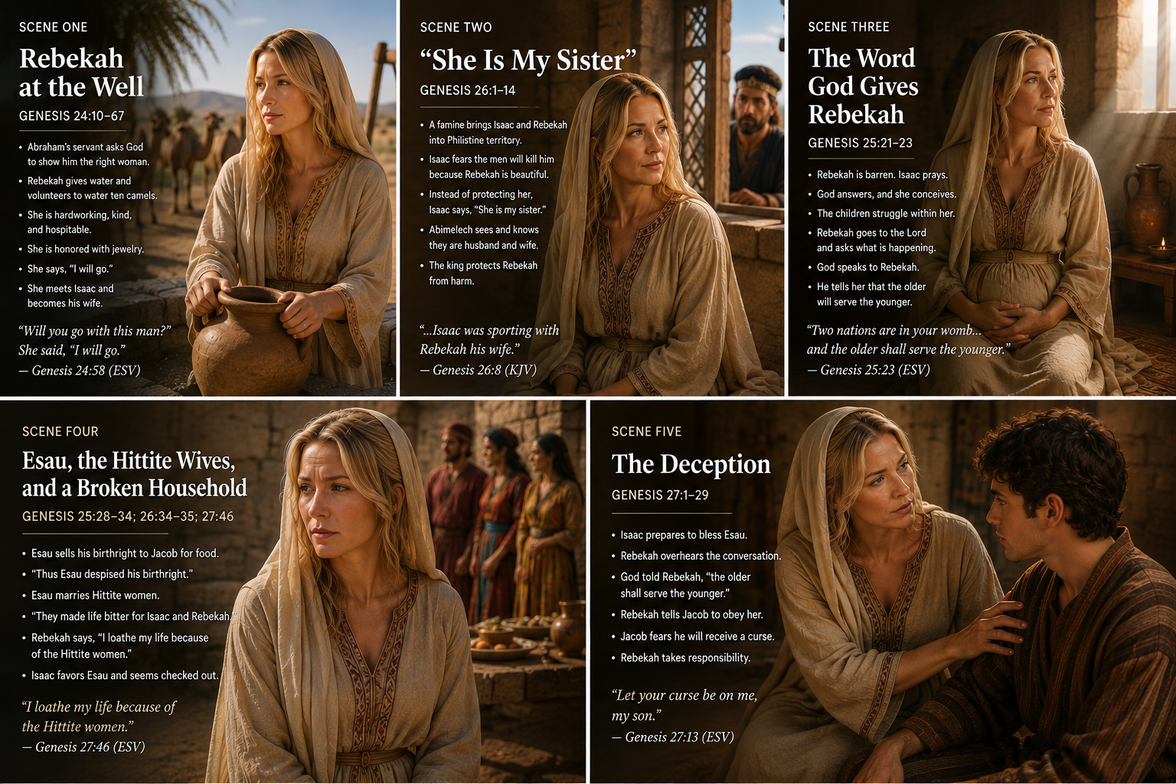
REBEKAH: WHAT DO YOU DO WHEN ALL YOU HAVE IS GOD’S WORD?
Genesis 24–27
Questions to Begin
- How do you know when you hear the Lord speak?
- How do you know how to apply what you are learning in the Bible?
- Who do you have to talk about these things with?
The story of Rebekah is not neat and clean. It begins as a beautiful love story but eventually becomes a story of marriage, children, disappointment, failure, faith, and a woman trying to understand what to do with something she believes God has told her.
Rebekah does not have the completed Bible. She cannot turn to Romans or read the New Testament. But God speaks to her concerning her children, and that word becomes important as everything around her begins to fall apart.
The question running through her story is simple:
What do you do when all you have is the Word God gave you?
I. REBEKAH: A PICTURE OF THE CHURCH
Before Rebekah enters the story, Isaac has already become a remarkable picture pointing forward to Jesus.
Isaac and Jesus
- Promised son — Genesis 17:19
Promised Son — Isaiah 9:6 - Beloved son — Genesis 22:2
Beloved Son — Matthew 3:17 - Carries the wood — Genesis 22:6
Carries the cross — John 19:17 - Willingly submits to his father — Genesis 22:9
Jesus willingly lays down His life — John 10:17–18
Then Genesis 24 introduces the bride.
Abraham sends his servant to find a wife for his promised son. The servant goes out, finds Rebekah, tells her about the son, adorns her, and asks her to come with him.
She has never seen Isaac.
Yet she says:
“I will go.” — Genesis 24:58
There is a beautiful picture here of Christ and His Church. The bride hears about the promised Son before seeing Him and responds in faith.
Rebekah leaves her old life and travels toward the bridegroom.
II. SCENE ONE — REBEKAH AT THE WELL
Genesis 24:10–67
The Scene
Abraham's servant arrives at a well with ten camels and asks God to show him the woman appointed for Isaac.
He asks for something specific: when he asks for water, the right woman will not only give him a drink but volunteer to water his camels.
Rebekah arrives.
She gives him a drink and then says:
“I will draw water for your camels also…” — Genesis 24:19
She runs back and forth drawing water until the camels are finished.
What We See in Rebekah
- She is beautiful.
- She is hardworking.
- She is hospitable.
- She serves without knowing there will be a reward.
- She does far more than the stranger actually asks of her.
Only afterward does the servant give her valuable jewelry and explain why he has come.
Eventually her family asks Rebekah herself:
“Will you go with this man?”
She answers:
“I will go.” — Genesis 24:58
She leaves home and travels to Isaac.
When she finally sees him in the field, she asks who he is, covers herself with her veil, and goes to meet him.
Genesis ends the scene beautifully:
“…she became his wife, and he loved her.” — Genesis 24:67
This is where we need to remember Rebekah when we reach the difficult parts of her story.
She begins as a woman of service and faith who willingly answers the call.
III. SCENE TWO — “SHE IS MY SISTER”
Genesis 26:1–14
The Scene
A famine comes, and Isaac and Rebekah find themselves living among the Philistines.
The men notice Rebekah because she is beautiful.
Isaac becomes afraid.
Instead of protecting his wife, he protects himself and tells them:
“She is my sister.” — Genesis 26:7
This is essentially the same failure we previously saw in Abraham.
Imagine the situation from Rebekah's perspective.
She left her family to come with this man. She became his wife. She trusted him. Now, when danger comes, Isaac is afraid that he will be killed because of her beauty.
So he calls her his sister.
But Then Abimelech Looks Through the Window
After they have been there for some time, Abimelech sees something that immediately exposes Isaac's lie.
This is the one place where the KJV wording captures what we discussed in the sermon:
“…Isaac was sporting with Rebekah his wife.” — Genesis 26:8 KJV
Whatever exactly was happening, Abimelech knows immediately:
That is not his sister. That is his wife.
There is still affection between Isaac and Rebekah.
Isaac has failed her terribly, but they are still together.
Abimelech then protects Rebekah:
“Whoever touches this man or his wife shall surely be put to death.” — Genesis 26:11
And God continues blessing Isaac.
The Point
The relationship has already experienced failure, but the love has not disappeared.
That becomes important as we watch their marriage change.
IV. SCENE THREE — THE WORD GOD GIVES REBEKAH
Genesis 25:21–23
The Scene
Rebekah cannot have children.
Isaac prays for her, and God answers.
She becomes pregnant.
But something unusual happens:
“The children struggled together within her…” — Genesis 25:22
Rebekah does something important.
She goes to the Lord herself.
And God speaks to Rebekah.
“Two nations are in your womb…”
Then comes the part that changes the rest of her story:
“…the older shall serve the younger.” — Genesis 25:23
Rebekah Has Heard From God
This is important because Rebekah does not have what we have.
She does not have the completed Scriptures.
She does not have Moses.
She does not have Romans.
She cannot compare fifty Bible passages and ask someone to explain them.
She has the word God gave her:
The older will serve the younger.
Paul later goes all the way back to this moment:
Romans 9:10–12
Before Jacob and Esau were born, God's purpose concerning them had been declared:
“The older will serve the younger.”
Rebekah is going to carry that word into everything that happens next.
V. SCENE FOUR — ESAU AND THE HITTITE WIVES
Genesis 25:28–34; 26:34–35; 27:46
The Scene
The family begins coming apart.
Isaac favors Esau.
Why?
Genesis gives an amazingly ordinary reason:
“Isaac loved Esau because he ate of his game…” — Genesis 25:28
Then Esau comes home hungry and sells Jacob his birthright for food.
Scripture summarizes what happened:
“Thus Esau despised his birthright.” — Genesis 25:34
Then Esau marries Hittite women.
Genesis tells us:
“They made life bitter for Isaac and Rebekah.” — Genesis 26:35
Eventually Rebekah says:
“I loathe my life because of the Hittite women.” — Genesis 27:46
Think About What Rebekah Is Watching
God told her that the older would serve the younger.
Then she watches the older son:
- Despise his birthright.
- Marry Hittite women.
- Bring bitterness into the family.
Meanwhile Isaac continues favoring Esau.
This is where the question of Isaac's involvement becomes important.
Isaac increasingly appears checked out of what is happening spiritually within his household.
Rebekah, however, still remembers what God told her.
VI. SCENE FIVE — THE DECEPTION
Genesis 27:1–29
The Scene
Isaac is old and his eyesight is failing.
He calls Esau and tells him to hunt game and prepare his favorite food.
Then Isaac intends to bless him.
Rebekah hears the conversation.
Now put yourself in Rebekah's position.
God told her:
“The older shall serve the younger.”
She has watched Esau despise the birthright.
She has watched his marriages bring bitterness into the family.
And now Isaac is preparing to bless Esau.
Rebekah acts.
She tells Jacob what they are going to do.
Interestingly, Jacob is the one who initially objects.
He is worried his father will discover what is happening.
Jacob says:
“…I shall bring a curse upon myself and not a blessing.” — Genesis 27:12
Then Rebekah says one of the most fascinating things in her entire story:
“Let your curse be on me, my son.” — Genesis 27:13
The Question Jessica Raised in Our Discussion
This is where the story becomes much more interesting than simply saying:
Rebekah lied, therefore Rebekah is the villain.
The text does not explicitly stop and say that Rebekah sinned.
That does not automatically make everything she did right.
But it raises a legitimate question:
Is Rebekah taking God's plan into her own hands, or is she desperately holding onto what God told her?
She knows what God said.
She sees everything apparently moving in the opposite direction.
And she acts.
That is something worth discussing rather than rushing past.
VII. “LET YOUR CURSE BE ON ME”
Jacob is afraid the curse will fall upon him.
Rebekah answers:
“Let your curse be on me, my son.” — Genesis 27:13
There is an interesting picture here that points us toward the Gospel.
Rebekah says:
Put the curse on me instead.
Later Scripture tells us something far greater about Jesus:
“Christ redeemed us from the curse of the law by becoming a curse for us…” — Galatians 3:13
Jacob fears the curse.
Rebekah says she will bear it.
And ultimately Christ actually bears the curse for His people.
CONCLUSION — WHAT DO YOU DO WITH WHAT GOD HAS SAID?
Rebekah's story begins at a well.
She serves.
She is chosen.
She hears about a promised son.
She is asked:
“Will you go?”
And she says:
“I will go.”
She becomes Isaac's wife, and Isaac loves her.
Then life becomes complicated.
Her husband fails her.
She cannot have children.
God answers prayer.
Her children fight inside her.
God speaks to her.
Her older son despises his birthright.
His marriages bring bitterness into her home.
Her husband appears increasingly disconnected.
And eventually Isaac prepares to bless Esau.
Through all of it, Rebekah remembers one thing:
“The older shall serve the younger.” — Genesis 25:23
That brings us back to the questions we started with:
1. How do you know when you hear the Lord speak?
2. How do you know how to apply what you are learning in the Bible?
3. Who do you have to talk about these things with?
Rebekah had to live out what she believed God had spoken in the middle of an extremely complicated family.
Her story should cause us to ask the same question:
What do I do with the Word of God when actually living it becomes complicated?