Did We Miss It? Babel, Pentecost, and Praying in the Spirit

Sermon Outline
Did We Miss It? Babel, Pentecost, and Praying in the Spirit
Main Point
The Holy Spirit unites every believer in Jesus Christ, and every believer can pray in the Spirit.
The main point of this sermon is not that every Christian speaks in tongues.
The main point is not that one denomination is right and another denomination is wrong.
The main point is not spiritual pride, spiritual fear, or spiritual confusion.
The main point is this:
Every believer who belongs to Jesus Christ has been brought into one family by the Holy Spirit, and every believer can pray in the Spirit.
Tongues matter because the Bible talks about them.
But tongues are not the center.
Jesus is the center.
The gospel is the center.
The Holy Spirit uniting the people of God is the center.
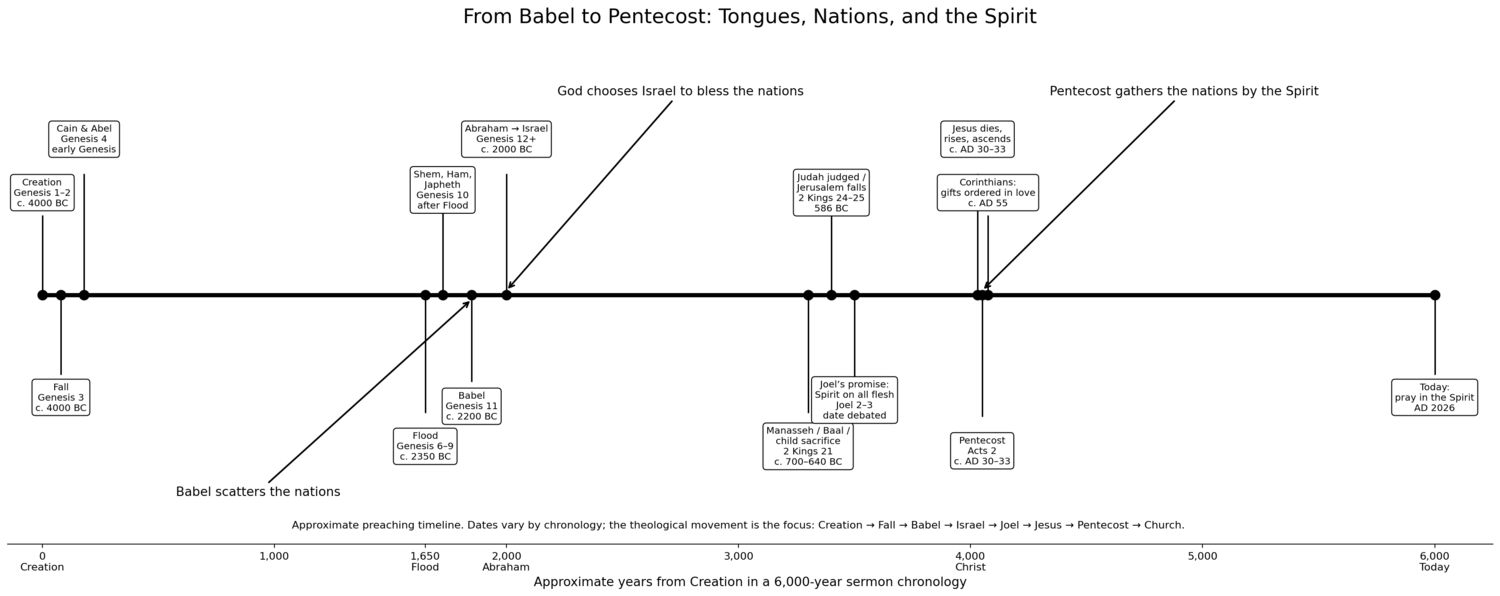
From Babel to Joel, from Joel to Pentecost, from Pentecost to Corinth, and from Corinth to the church today, God has been showing one massive redemptive truth:
Sin scattered the nations, but Jesus gathers the nations by the Holy Spirit.
1. We Missed the Bigger Story
Many Christians have argued about tongues for years.
Some Pentecostals have focused so much on tongues that they have sometimes made tongues the sign of whether someone truly has the Spirit.
Some Baptists and other non-charismatic Christians have reacted so strongly against abuses that they have sometimes missed what the Bible actually says about praying in the Spirit.
Some Christians have made tongues too important.
Some Christians have acted like tongues do not matter at all.
But both sides can miss the bigger story.
The bigger story is not merely about the gift of tongues.
The bigger story is about the Holy Spirit uniting people who were once divided.
The bigger story is about God gathering the nations back to Himself through Jesus Christ.
The bigger story is about the gospel going to every tribe, tongue, people, and nation.
The bigger story is about this:
If you have Jesus Christ, you are united by the Spirit, and you can pray in the Spirit.
2. The Story Begins with Creation
In the beginning, God created the heavens and the earth.
God spoke, and creation obeyed.
God made Adam.
God made Eve.
God made mankind in His image.
Adam and Eve were made for communion with God and communion with one another.
They were bone of bone and flesh of flesh.
They were created for unity, life, love, worship, and fellowship with God.
There was no sin.
There was no death.
There was no confusion.
There was no division.
There was no separation between peoples and nations.
Humanity began in communion with God.
3. Sin Brings Division, Death, and Confusion
When Adam and Eve sinned, everything changed.
The first sin was mankind trying to become like God apart from God.
That same sinful desire is still at the root of human rebellion:
We want to be our own gods.
Once sin entered the world, death followed.
Cain killed Abel.
The family was broken.
The human heart became violent.
By the time of Noah, the world was filled with corruption and bloodshed.
The thoughts of man’s heart were continually evil.
God judged the world through the flood, but He preserved Noah and his family.
Noah had three sons:
-
Shem
-
Ham
-
Japheth
From these three sons came the nations of the earth.
4. Genesis 10 and the Table of Nations
Genesis 10 gives the Table of Nations.
It shows the spread of peoples, families, clans, lands, and nations after the flood.
Genesis 10 shows the nations spreading across the earth.
Genesis 11 then explains one of the most important spiritual reasons behind that scattering.
Genesis 10 gives the map.
Genesis 11 gives the theological meaning.
5. Babel: One Language Used for Rebellion
Genesis 11 says that the whole earth had one language and the same words.
At Babel, mankind was united in language.
But they were not united in worship.
They were not united in obedience.
They were united in rebellion.
The people said:
“Let us make bricks.”
“Let us build a city.”
“Let us build a tower.”
“Let us make a name for ourselves.”
“Let us not be scattered.”
This was not just architecture.
This was spiritual rebellion.
They were trying to build their way into the heavens.
They were trying to make their own name great.
They were trying to create unity without God.
They were trying to reach heaven on their own terms.
At Eden, mankind wanted to be like God.
At Babel, mankind wanted to make a name for itself.
The same sin was still alive:
Humanity wanted glory without submission to God.
6. God Confuses the Languages
God came down and saw the city and the tower.
The people thought they were reaching heaven, but God still had to come down to see what they were building.
God confused their language.
God scattered them over the face of the earth.
At Babel, one people with one language became many peoples with many tongues.
This was judgment.
But it was also mercy.
God restrained unified human rebellion.
He stopped mankind from gathering together in one massive anti-God kingdom.
At Babel:
Language was divided.
The nations were scattered.
Humanity was confused.
Sin had separated man from God, and now sinful mankind was separated from one another.
7. Babel Is Not the End of the Story
Babel is not the end.
Right after Babel, God calls Abraham.
God promises Abraham that through his seed all the families of the earth will be blessed.
That means God did not abandon the nations.
God scattered the nations at Babel, but He promised to bless the nations through Abraham.
Abraham’s family became Israel.
Israel became the chosen nation.
But God’s plan was always bigger than one nation.
God chose one nation through whom He would bless all nations.
8. Israel Also Needed Redemption
Israel was called to be a light to the nations.
But Israel also sinned.
Israel worshiped false gods.
Israel built false altars.
Israel sacrificed children.
Israel became like the nations instead of shining as a light to the nations.
The chosen nation also needed salvation.
The nations needed redemption.
Israel needed redemption.
All humanity needed redemption.
The answer would not come through mankind climbing back up to God.
The answer would come through God coming down to save mankind.
9. Joel Promises the Pouring Out of the Spirit
The prophet Joel speaks in the context of judgment, repentance, restoration, and the day of the Lord.
Joel promises that a day is coming when God will pour out His Spirit.
This promise is massive.
God says He will pour out His Spirit on all flesh.
That includes sons and daughters.
That includes old men and young men.
That includes male servants and female servants.
The Spirit will not only come upon kings.
The Spirit will not only come upon prophets.
The Spirit will not only come upon priests.
God promises a day when His Spirit will be poured out broadly on His people.
Joel also says:
Everyone who calls on the name of the Lord shall be saved.
This promise points forward to the gospel.
The Spirit will be poured out.
The name of the Lord will be called upon.
People will be saved.
The nations will be gathered and judged.
God will act in history.
10. Jesus Fulfills the Promise
Jesus Christ comes as the promised Seed.
He is the Seed of the woman who crushes the serpent.
He is the Seed of Abraham through whom the nations are blessed.
He is the true Israel.
He is the Son of David.
He is the Savior of the world.
Jesus dies on the cross.
Jesus is buried.
Jesus rises from the dead.
Jesus ascends to the Father.
Jesus pours out the Holy Spirit.
The gospel is not humanity building a tower up to God.
The gospel is God coming down to save sinners.
Babel says, “Let us go up.”
The gospel says, “God came down.”
Babel says, “Let us make a name for ourselves.”
The gospel says, “Everyone who calls upon the name of the Lord shall be saved.”
11. Pentecost: God Begins Reversing Babel
Acts 2 is one of the most important moments in redemptive history.
The disciples are gathered.
The Holy Spirit comes.
Tongues like fire rest upon them.
They are filled with the Holy Spirit.
They begin to speak with other tongues as the Spirit gives them utterance.
The Spirit gave the utterance.
They did not manufacture this.
They did not fake it.
They did not hype it up.
The Holy Spirit gave them speech.
Acts 2 says there were devout Jews in Jerusalem from every nation under heaven.
That phrase matters.
At Babel, the nations were scattered.
At Pentecost, representatives from the nations were gathered.
At Babel, God confused language.
At Pentecost, God used language as a sign of redemption.
The crowd heard the mighty works of God in their own languages.
This was not meaningless noise.
This was not empty repetition.
This was not pagan babbling.
They heard and understood the mighty works of God.
Some were amazed.
Some mocked and said the disciples were full of new wine.
The same event produced two responses:
Some heard the works of God.
Some thought they were drunk.
Then Peter stood up and explained what was happening.
Peter said this was what Joel had spoken about.
The promised Spirit was being poured out.
Peter did not make tongues the main point.
Peter preached Jesus.
Jesus crucified.
Jesus risen.
Jesus exalted.
Jesus made both Lord and Christ.
The people were cut to the heart.
They asked, “What shall we do?”
Peter told them to repent and be baptized in the name of Jesus Christ for the forgiveness of sins, and they would receive the gift of the Holy Spirit.
About 3,000 souls were added.
At Babel, the people were scattered by divided tongues.
At Pentecost, people from many tongues were gathered by one gospel.
At Babel, language was a sign of judgment.
At Pentecost, language became a sign that God was gathering the nations through Jesus Christ.
12. The Holy Spirit Creates One New People
The Holy Spirit unites what sin divided.
Sin divided humanity from God.
Sin divided humanity from one another.
Babel scattered the nations.
But Jesus gathers one people by the Holy Spirit.
In Christ, there is one body.
There is one Spirit.
There is one hope.
There is one Lord.
There is one faith.
There is one baptism.
There is one God and Father of all.
Earthly nations still exist.
Cultures still exist.
Languages still exist.
Flags still exist.
But every earthly identity is secondary to Jesus Christ.
A Christian from another nation is closer to me eternally than an unbeliever from my own nation.
A believer in Christ is my brother or sister, no matter their tribe, tongue, color, nation, or earthly flag.
One day every earthly kingdom will fall.
One day every earthly flag will fade.
But the kingdom of Jesus Christ will never end.
The banner over the people of God is Jesus Christ, the Lamb who was slain.
13. Tongues Must Not Become the Main Point
Tongues are biblical.
Tongues matter.
But tongues are not the main point.
The gospel is the main point.
The Holy Spirit uniting the people of God is the main point.
Love is the main point.
Edification is the main point.
Jesus is the main point.
Some Christians make tongues too important.
Some Christians act like tongues are not in the Bible.
Some Christians fake spiritual experiences.
Some Christians mock real spiritual gifts.
The biblical answer is not fear.
The biblical answer is not pride.
The biblical answer is not chaos.
The biblical answer is submission to Scripture and love for the body of Christ.
14. Four Categories of Tongues or Spiritual Speech
1. Counterfeit or Pagan Speech
Not every spiritual utterance comes from the Holy Spirit.
Jesus warned against praying like the Gentiles, who heap up empty phrases and think they will be heard for their many words.
The prophets of Baal cried out, raved, cut themselves, and worked themselves into a frenzy.
That was not the Holy Spirit.
That was false worship.
There is such a thing as counterfeit spiritual activity.
There is such a thing as manufactured religious speech.
The people of God must test the spirits.
The Holy Spirit is holy.
The Holy Spirit does not need manipulation.
The Holy Spirit does not need performance.
The Holy Spirit does not produce pagan chaos.
2. Pentecost Tongues as a Sign of the Gospel Going to the Nations
At Pentecost, the disciples spoke as the Spirit gave them utterance.
The people heard the mighty works of God in their own languages.
These tongues were a sign that God was gathering the nations.
This moment connects back to Babel.
At Babel, one language became many because of judgment.
At Pentecost, many languages heard one gospel because of grace.
This was not merely about tongues.
This was about the gospel.
This was about Jesus.
This was about the Spirit being poured out.
This was about God gathering people from every nation into one body.
3. Congregational Tongues with Interpretation
In 1 Corinthians 12, Paul says the Spirit gives different manifestations to different believers.
Among those gifts are various kinds of tongues and the interpretation of tongues.
In the gathered church, tongues must be interpreted.
If there is no interpretation, the speaker should remain quiet in the church and speak to himself and to God.
Public tongues are not supposed to create disorder.
Public tongues are not supposed to draw attention to the speaker.
Public tongues are not supposed to confuse the church.
The purpose of spiritual gifts is to build up the body.
The Holy Spirit gives gifts for edification, not chaos.
4. Private Prayer Language and Praying in the Spirit
Paul also describes praying in a tongue where the spirit prays but the mind is unfruitful.
This is prayer directed to God.
This is not public instruction.
This is not preaching.
This is not something to use as a badge of spiritual superiority.
If the Spirit gives this kind of prayer, it should be handled with humility, holiness, and love.
But praying in the Spirit is bigger than praying in tongues.
Not every Christian speaks in tongues.
But every Christian can pray in the Spirit.
15. Praying in the Spirit Is for Every Believer
Every believer who belongs to Jesus Christ has the Holy Spirit.
When a person believes the gospel, that person is sealed with the promised Holy Spirit.
The Spirit is the guarantee of our inheritance.
So the first step in praying in the Spirit is not tongues.
The first step is Jesus.
You need the gospel.
You need Christ.
You need to be born again.
You need the Spirit of God.
If you belong to Christ, you have the Spirit.
And if you have the Spirit, you can pray in the Spirit.
16. Four Ways Believers Can Pray in the Spirit
1. Pray in Tongues Privately, If the Spirit Gives That Gift
Some believers pray in tongues privately.
Paul describes praying in a tongue where the spirit prays and the mind is unfruitful.
This kind of prayer is between the believer and God.
It is not for showing off.
It is not for spiritual pride.
It is not the proof that someone is better than another Christian.
It is prayer.
For if I pray in an unknown tongue, my spirit prayeth, but my understanding is unfruitful. — 1 Corinthians 14:14
What is it then? I will pray with the spirit, and I will pray with the understanding also. — 1 Corinthians 14:15
2. Pray by Asking the Spirit to Give You Words
Sometimes believers know they need to pray, but they do not know what to say.
In those moments, the Spirit helps.
The Spirit brings Scripture to mind.
The Spirit gives wisdom.
The Spirit leads the heart toward the Father.
The believer can simply say:
“Holy Spirit, help me pray.”
This is praying in the Spirit.
Praying always with all prayer and supplication in the Spirit. — Ephesians 6:18
But ye, beloved, building up yourselves on your most holy faith, praying in the Holy Ghost. — Jude 20
3. Pray Through Groaning Too Deep for Words
Sometimes prayer is deeper than words.
Sometimes a believer is so broken, confused, burdened, or weak that words will not come.
Romans 8 says the Spirit helps us in our weakness.
When we do not know what to pray as we ought, the Spirit Himself intercedes for us with groanings too deep for words.
This is one of the most powerful forms of praying in the Spirit.
Prayer is not only speaking.
Sometimes prayer is groaning.
Sometimes prayer is weeping.
Sometimes prayer is sitting silently before God because the heart is too heavy for language.
The Father knows.
The Spirit intercedes.
God hears what the believer cannot even explain.
Likewise the Spirit also helpeth our infirmities: for we know not what we should pray for as we ought. — Romans 8:26
But the Spirit itself maketh intercession for us with groanings which cannot be uttered. — Romans 8:26
And he that searcheth the hearts knoweth what is the mind of the Spirit. — Romans 8:27
Because he maketh intercession for the saints according to the will of God. — Romans 8:27
And because ye are sons, God hath sent forth the Spirit of his Son into your hearts, crying, Abba, Father. — Galatians 4:6
4. Pray Through Spirit-Led Intercession with Other Believers
The gathered church is not only a place where Christians listen.
It is a place where Christians minister to one another.
Believers are called to pray for one another.
The Bible shows believers laying hands on others in prayer, blessing, healing, commissioning, and receiving ministry.
Laying on hands is not supposed to be strange or theatrical.
It is a biblical picture of identification, blessing, prayer, and Spirit-led ministry.
When believers pray for one another, the body of Christ is strengthened.
When believers carry one another’s burdens, the love of Christ is made visible.
When believers lay hands on one another with wisdom, purity, and order, the church practices biblical intercession.
Then laid they their hands on them, and they received the Holy Ghost. — Acts 8:17
And Ananias went his way, and entered into the house; and putting his hands on him said, Brother Saul, the Lord, even Jesus, hath sent me. — Acts 9:17
And when they had fasted and prayed, and laid their hands on them, they sent them away. — Acts 13:3
And when Paul had laid his hands upon them, the Holy Ghost came on them. — Acts 19:6
Neglect not the gift that is in thee, which was given thee by prophecy, with the laying on of the hands of the presbytery. — 1 Timothy 4:14
Wherefore I put thee in remembrance that thou stir up the gift of God, which is in thee by the putting on of my hands. — 2 Timothy 1:6
Is any sick among you? let him call for the elders of the church; and let them pray over him. — James 5:14
They shall lay hands on the sick, and they shall recover. — Mark 16:18
Laying on hands must be done with wisdom.
It must be done with purity.
It must be done with order.
It must be done in love.
It must never be used to manipulate, pressure, or perform.
It is a way the body of Christ prays together.
17. True Praying in the Spirit Produces Love and Unity
The Spirit does not produce pride.
The Spirit does not produce chaos.
The Spirit does not produce spiritual competition.
The Spirit produces love.
This is why 1 Corinthians 13 is placed between 1 Corinthians 12 and 1 Corinthians 14.
Paul talks about spiritual gifts in chapter 12.
Paul talks about love in chapter 13.
Paul gives order for tongues and prophecy in chapter 14.
That means gifts must be governed by love.
Tongues without love are noise.
Knowledge without love is nothing.
Spiritual experiences without love do not build the church.
The true evidence of the Spirit is not arrogance.
The true evidence of the Spirit is Christlike love.
Though I speak with the tongues of men and of angels, and have not charity, I am become as sounding brass, or a tinkling cymbal. — 1 Corinthians 13:1
Charity suffereth long, and is kind; charity envieth not; charity vaunteth not itself, is not puffed up. — 1 Corinthians 13:4
Let all things be done decently and in order. — 1 Corinthians 14:40
18. Communion: Practicing Prayer in the Spirit
Communion is common union.
Communion is not only an individual moment.
It is a family moment.
It is the people of God remembering the body and blood of Jesus together.
At the table, believers remember the gospel.
Jesus died for sinners.
Jesus shed His blood for the forgiveness of sins.
Jesus rose from the dead.
Jesus gives His Spirit to His people.
Jesus makes His people one body.
During communion, the church can practice praying in the Spirit.
Some may pray quietly in tongues between themselves and God.
Some may ask the Spirit for words.
Some may sit silently and groan before the Father.
Some may come forward and receive prayer from other believers.
Some may lay hands on family members or friends and pray for them.
Some may simply talk to the Father through Jesus by the Holy Spirit.
The point is not performance.
The point is communion with God.
The point is dependence on the Spirit.
The point is the body of Christ ministering to one another in love.
19. Final Exhortation
Do not miss the point.
Babel was not the end of the story.
God scattered the nations because of sin.
But God promised Abraham that all the families of the earth would be blessed.
God promised through Joel that He would pour out His Spirit.
Jesus came.
Jesus died.
Jesus rose.
Jesus ascended.
Jesus poured out the Holy Spirit.
At Pentecost, many tongues heard one gospel.
Peter preached Christ.
Three thousand were baptized and added.
The church was born.
The nations began to be gathered.
That same Holy Spirit still unites the people of God today.
So the message is clear:
If you belong to Jesus Christ, you are united by the Spirit.
And:
If you belong to Jesus Christ, you can pray in the Spirit.
Not every Christian speaks in tongues.
Not every Christian has the same gift.
But every Christian has access to the Father through the Son by the Holy Spirit.
So pray.
Pray with words.
Pray with Scripture.
Pray with tears.
Pray with groaning.
Pray in silence.
Pray with other believers.
Pray at the table.
Pray in the gathering.
Pray at home.
Pray when you know exactly what to say.
Pray when you do not know what to say at all.
The Spirit helps us in our weakness.
The Spirit intercedes for the saints.
The Spirit unites the church.
The Spirit glorifies Jesus.
We are one body.
We have one Spirit.
We belong to one Lord.
We are one family.
And we can pray in the Spirit.
Amen.